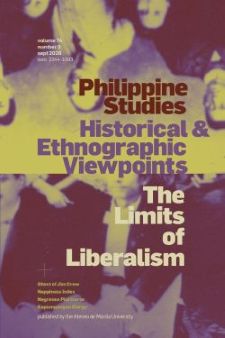
Philippine Studies: Historical and Ethnographic Viewpoints is an internationally refereed journal (double-blind peer review) that publishes scholarly articles and other materials on the history of the Philippines and its people, both in the homeland and overseas.
It believes the past is illuminated by historians as well as scholars from other disciplines; at the same time, it prefers ethnographic approaches to the history of the present. It welcomes works that are theoretically informed but not encumbered by jargon. It promotes a comparative and transnational sensibility and seeks to engage scholars who may not be specialists in the Philippines. Founded in 1953 as Philippine Studies, the journal is published quarterly by the Ateneo de Manila University, where the journal is indexed in Scopus (Elsevier), Emerging Sources Citation Index (Clarivate), ASEAN Citation Index, Historical Abstracts (EBSCO), Bibliography of Asian Studies (EBSCO), International Bibliography of the Social Sciences (ProQuest), a host of other international indexing services, the latest being the ASEAN Citation Index.
All submitted works must be written in English. The journal also accepts translations of previously published works in non-English languages, although such works must also pass blind peer review. The journal accepts research articles (8,000 to 10,000 words), research notes (essays less than 8,000 words long that present preliminary findings and/or insights of a research work), and documentary sources (reproduction/translation/transcription of primary sources that will be useful to other Philippinists). The journal does not accept unsolicited book reviews, review essays, professorial addresses, and obituaries.
The average time between acceptance and publishing is forty to sixty days.
See the Aims and Scope for complete coverage of the journal.
To request for access to articles, please email [email protected]
Current Issue: Volume 74, Number 3 (2026) The Limits of Liberalism
Editor's Introduction
Editor’s Introduction
Michael D. Pante
Articles
The Filipino Worker and the Affective Limits of Early Twentieth-Century Liberalism and Nationalism in the Philippines and the United States
Veronica C. Alporha
“She’s Not Black”: Filipino Americans in the Desegregating American South
Enrique Miguel Seward Limón
Happiness as a Measure of National Development: Insights from the Emergence and Abandonment of the Philippine Happiness Index
John O. de la Cruz
Decolonizing Religion and Sexuality: Asserting Pluriversality in Rosario Cruz-Lucero’s Feast and Famine: Stories of Negros
Farah Aimee S. Virador
Documenting Narratives of Church Engagements in the Archdiocese of San Fernando, 1972–1986
Joseph Dizon
Book Reviews
Thomas McKenna's Moro Warrior: A Philippine Chieftain, an American Schoolmaster, and the Untold Story of the Most Remarkable Resistance Fighters of World War II in the Pacific
Nick John F. Estonilo
Soliman M. Santos Jr.'s Tigaon 1969: Untold Stories of the CPP-NPA, KM, and SDK
Javier Leonardo V. Rugería
Fernando Zóbel's Fernando Zóbel: Essential Texts
Charlie Samuya Veric
Research Note
From “Robs to Riches”: Scandal Constructivation and the Ambivalent Work of Pagsasaayos
Karl Patrick R. Mendoza